Tyr in Spring
Note: This article is in the Spring 2026 Edition of the Troth’s Idunna. I have posted it here in case others are interested. For those of you who only know me through 8hoof, you might be surprised to learn that I actually work with Tyr more than Odin. But that’s a story for another time…!
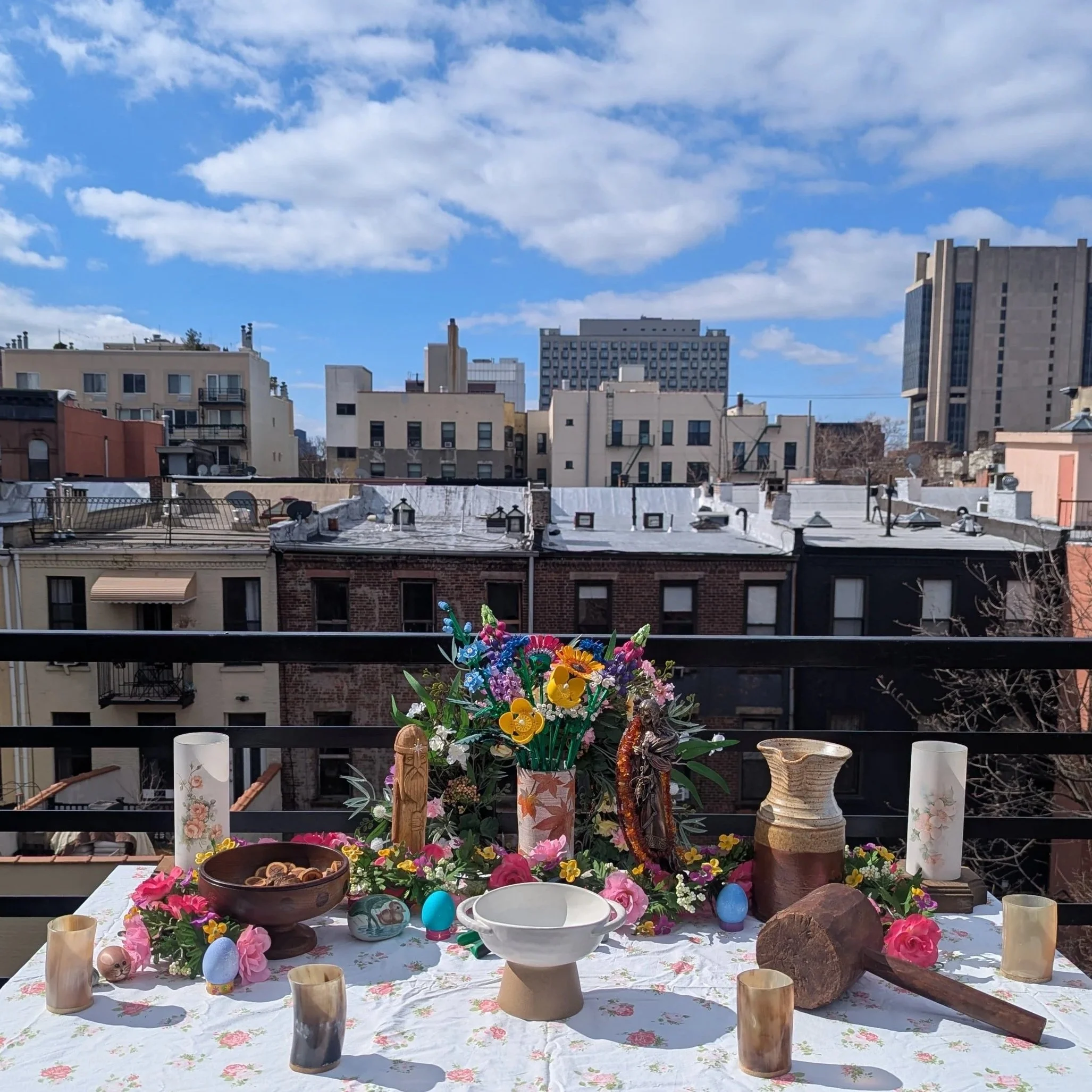
Spring Equinox altar to Oschdra, Zisa, and Tyr.
Here in New York City, the days have been getting longer and Sunna’s light stronger. The buds are starting to swell and the spring ephemerals are beginning to peek out of the ground. I had a friend staying with me who is interested in Heathenry, so I figured it would be a good time for one of my favorite rituals of the year: telling the story of Oschdra and her Sisters Hellig and Nacht, collectively called the Oschdre Sisters.
Now if you’re not familiar with the Oschdre Sisters, please look them up! You can find them online in the Urglaawe pages, or in the new Heathen Traditions of the Pennsylvania Dutch book. However, as fascinating as these brilliant entities are, this article is actually about to take a hard turn away from them and toward a more well-trodden groove in my personal practice: Tyr!
The Spring Ritual
The ritual began with honoring Oschdra and discussing the scant historic evidence about Ostara and Eostra. We discussed how she is the Bringer of Color. She strives to be more than she was and, along with her Sisters, has a deep magic for transformation and growth. We then reflected on liminality and the new Hare Moon, how we were astride the years: past the equinox for the start of the solar year, but before the Woodcock Moon, which is the Urglaawe lunisolar start to the year.
As I was preparing the outline and themes for the ritual, I started writing up a mid-ritual meditation. This is a practice I’ve picked up from Winifred Hodge-Rose after reading the many rituals she’s posted on her Heathen Soul Lore website. I began writing the meditation out:
Imagine a late winter forest clearing. Snow is on the ground but it’s patchy now, relegated to the hollows and shadowy sides of the land. It’s a pre-industrial time, where people have set up a home. They are living in harmony with the land: mindfully felling some trees and saplings, opening up clearings for productive plants to grow, and a small number of livestock complementing the home. Human beings living in harmony with the plant beings and animal beings.
In this clearing there is a persistently muddy patch. A depression where water continually is seeping out. Dribbling, unchanneled, oozing wherever it may go, taking the path of least resistance downhill. It’s a muddy area, difficult to cross… but this is a site of powerful potential: a local ground spring.
Now imagine the spring becoming a well. The people work to clear the turf and mud. Stones are set. A ring or a square is made around the spring, large stones grouted with clay to channel seepage. The waters slowly rise within, guided and directed by the stones. It becomes a well, with an overflow in one channeled spot. A clear stream is established and the muddy area becomes green and thriving with onion grass and spring herbs.
Sit with that process: the undirected flow channeled into a well. The constraint setting a sacred space for the water to rise. The shaping and the forming of the stones channeling the clear water. The boundaries we set.
Reflect on the cold mud that was cleared away to create the clear waters. A clear purpose. Meditate on the things we release to create space for our potential to rise.
…..
And meditate on the boundaries we set. The Protections placed so the spring surging forth can remain clear. Meditate on the boundaries you’re setting in your life to ensure your potential is harnessed.
…..
The things we release will set our course for the year. These are boundaries we set will channel our actions for the year.
Hail to the wellspring!
And suddenly, I realized this was more than a ritual to Oschdra. She is still the star of the show, though instead of color, I represent her as the potential of the year, surging forth in the symbolism of the spring. But then Tyr’s wife Zisa, the Remover of Obstacles, manifests in the act of clearing away debris and ensuring the waters emerge with clarity. And finally Tyr himself appears, setting forth the boundaries, the laws to channel our clarified potential.
I began doing a deeper reflection on why Tyr feels like a spring deity. I had just presented an article about this topic for the monthly discussion with the Uthellingu Kindred in Central New York. So I took my notes and expanded them into the thoughts below. The article is by Norwegian academic Eldar Heide, titled Týr and Viðarr: Equinox, Wolves and Old Norse Celestial Traditions, published in the Nordic Yearbook of Folklore 2024. I also include a mix of personal insights throughout.
Tyr and the Equinox
Let me begin by saying that seasonality is deeply important to me in my practice. I revel when I can see my gods at work in the “mundane” world. I love seeing Thor in the thunderstorms, Odin in the winds and crossroads, Frigg in the fens, and Oschdra in the colorful spring ephemerals. And, as one of the deities I feel close to, I have always sought ways to connect Tyr with the evolving world. And in doing so, he does seem to always appear in spring.
From Tacitus, Tyr is connected with Mars, the Roman God of War and Agriculture. The connection between war and agriculture may seem strange in a modern era, but they were intimately connected until relatively recently. Standing armies did not regularly appear in Europe until the 15th and 16th centuries. Prior to this development, rulers would call up conscripts each spring. But these conscripts would only leave their homes until after the fields were sown. War was a summer activity between the planting and the harvest. Obviously this is a gross oversimplification, and there were certainly rulers who did not follow this path (much to the detriment of social order). But Mars became associated with spring for this reason. Even today we call the month March after Mars, which in the original Latin meant “dedicated to Mars.”
Being connected with Mars, Tyr could then be viewed as part of this ancient rhythm of warfare and the month of March. But Eldar Heide’s article speculates that Tyr was honored during the month of March independent of any connection to Mars, specifically being honored on the Spring Equinox. His arguments hinge on celestial phenomena and some place name evidence.
Celestial Associations
His celestial rationale is based upon a list of constellation names attested in a 12-13th century Icelandic manuscript (Gks 1812 4to or Alfræði íslenzk). In this manuscript, two constellations are called Ulfskjǫptr / Ulfskeptr, and Ásar bardagi, which he translates to “Wolf’s Jaws” and “God’s Battle.” Wolf’s Jaws is the star cluster Hyades, part of the constellation Taurus. It forms a “V” in the sky, which could represent the horns of a bull (to the Greeks) or the jaws of a wolf (to ancient Heathens). Around 2,000 years ago, the sun would set between these “jaws” during the spring equinox. Heide equates this to the idea of Fenrir eating the sun at Ragnarok, and believes the wolf’s jaw represents Fenrir’s maw. Heide suggests ancient Heathens would see Ragnarok forestalled every year because another force is protecting Sunna from the wolf’s jaws: Tyr, represented by the other constellation “God’s Battle.”
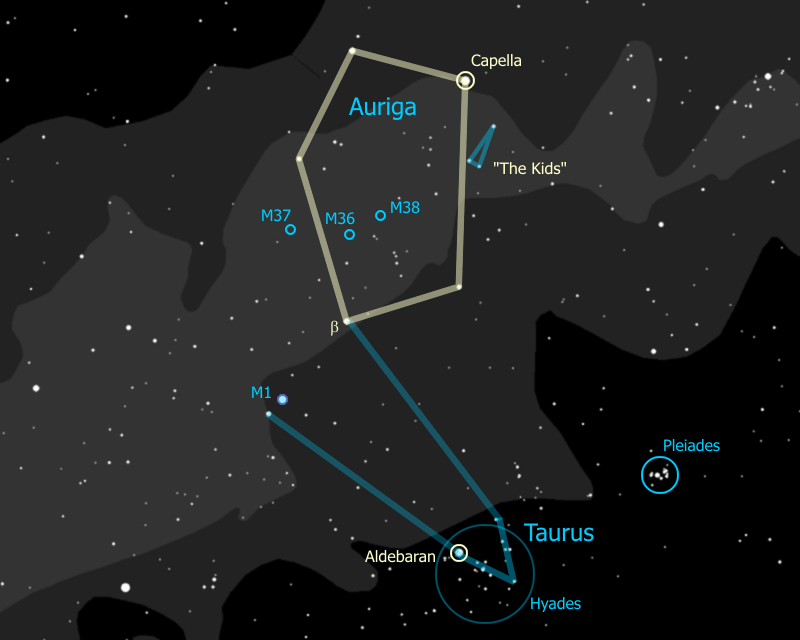
The box of Auriga was called “God’s Battle” potentially referencing Tyr. The “V” constellation of Taurus was called “Wolf’s Jaw.”
“God’s Battle” is known to us as the constellation “Auriga,” located just above the Wolf’s Jaw at the edge of the mouth. The Icelandic manuscript doesn’t identify which god is battling, but Heide believes it to be Tyr, cosmically in “battle” with Fenrir. Each spring, Sunna is protected from Fenrir by Tyr battling the wolf. He uses the Old English Rune Poem as further support for this claim. The poem for the tiw rune (represented by Tyr) starts with “ᛏ biþ tacna...” “Tacna” has many meanings. It is related to our modern English “token” but can also represent a sign, a distinguishing mark, a signal, a symbol or emblem, an indication of a medical symptom, or - as it is used in Icelandic - a constellation. Thus providing support for the idea of Tyr represented by a constellation, and that constellation being “God’s Battle.”
Tyr Placenames
He also uses the geography of Tyr placenames as a supporting argument, specifically that there are no Tyr place names in Iceland. He argues that Iceland was settled after Tyr fell out of favor among the Ancient Heathens, and he fell out of favor because the mythic dance between Sunna, Fenrir, and Tyr fell apart. In around 500-600 CE, the sun was no longer aligned with Wolf’s Jaw during the equinox. Tyr’s role as protector would have been diminished, and Heide argues that this gives context for the apparent loss of Tyr’s status as a sky god. His wolf battling duties were relegated to a new god, Viðar, and Tyr himself would lose his hand. To his point, Tyr’s place names are in Denmark and southern Scandinavia, where people were living before 500 CE. However, there are no places named in honor of Tyr in Iceland, which was settled past 600 CE. And so, when the sun is no longer aligned with Wolf’s Jaw, new settlements were no longer named after Tyr.
However, the foundation of this argument hinges on the importance of the equinox to the worship of Tyr, as there is no evidence directly tying Wolf’s Jaw to Fenrir’s maw, or Tyr being the god referenced in God’s Battle. This is where Heide considers the specific topography of these places.
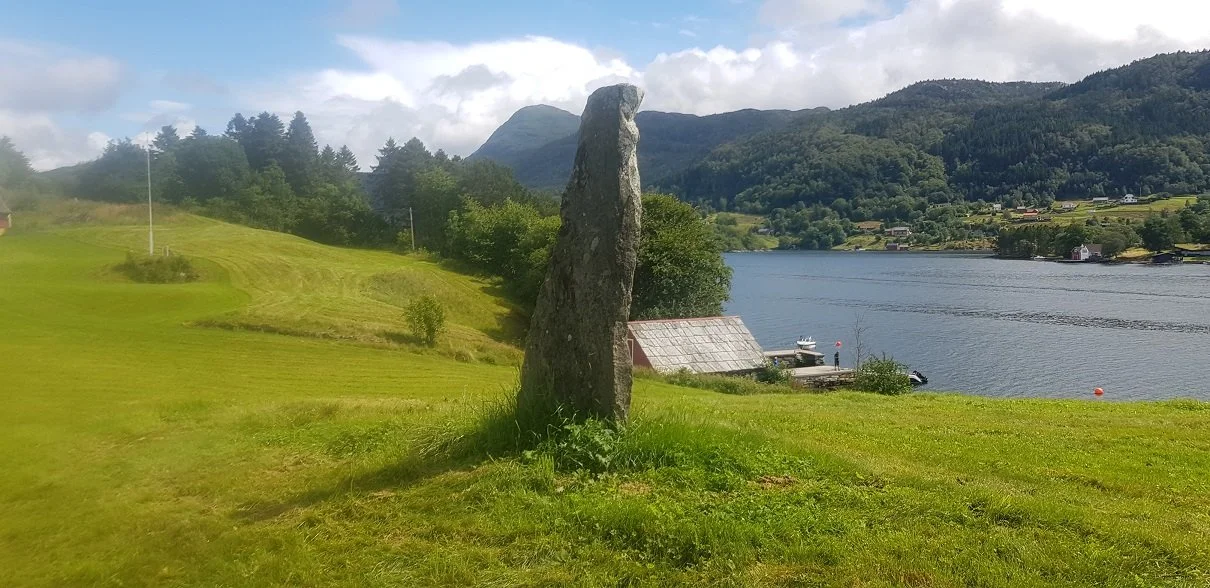
Image of a standing stone near the cairn at the Tysnes / Todneset Headland.
As previously mentioned, many of them are hills or headlands. These all have promintories on an east-west alignment, or a ridge on the eastern or western side, with notable views directly east or directly west. And during the equinox, the sun rises directly in the east and sets directly in the west, creating natural sites for worship associated with the sunrise or sunset at the equinox. Týsnes, in southern Norway, is his prime example. Týsnes, now called Todneset, is a west facing headland that is also east-west aligned. It also has a unique solar phenomenon, explained by Heide directly below:
At the winter solstice, the gorge in which the sun reappears is so close that the sun shines with a concentrated beam on to a 20-metre-wide prehistoric cairn at the top of the headland. Around the solstices, this happens for several days, while on the equinoxes, it occurs only on that exact day.
According to megalithic.co.uk: Buried within the center of the cairn is a platform of several flat stone slabs with numerous burned animal bones and seashells, potentially an altar. And so Heide resolves that this place reinforces the equinox-as-important-to-Tyr argument.
I should note that the article also include a lot of other information that I did not cover. He discusses the Viðar connection in much more detail, and also takes time to underscore the connection between the sun and the wolf chasing her. I do encourage you to review the article yourself!
Conclusions
Personally, I find a lot of Heide’s arguments difficult to support. The leaps of logic are a bit too large for me to critically accept as historic fact. It seems clear the equinoxes would have been important at the Týsnes / Todneset cairn and, given the name, I can believe the location was used for worship to Tyr and then later buried when his practice waned. Heide paints a compelling picture of the decline of Tyr’s myth in relation to a constellation shifting out of alignment with the equinox. But I am skeptical to say that there was some kind of historic consensus that connected Tyr directly with the spring equinox.
However, as a Heathen, I can be skeptical while also looking to my living gods. And, for lack of a better phrase, the vibes are actually pretty good here. As evidenced by the ritual meditation in the beginning of this article, I have personally felt Tyr calling me in the spring, calling for me to plan and prepare for the year. It’s not quite going to war, but modern life certainly has its combative elements! So in this way, I do seem him aligned with the Roman Mars.
I am not feeling the celestial aspects of his article as much though, specifically the aspect of Tyr in the God’s Battle constellation. I do look to Tyr in the sky for guidance, as per the Old English Rune Poem. But this constellation does not fit my UPG, as the Tyr I know does not battle Fenrir or any other wolf. I could see the constellation representing Viðar, given that he was honored for battling the Wolf during the recording of the manuscript. In fact, we specifically are told how Viðar tore the Fenrir’s jaw, which looks very closely to what the stars represent. But for Tyr, I will look elsewhere in the sky.
Regarding the equinox, I had not considered it in relation to Tyr specifically before this article. I see him in good laws and see him in binding and connecting people, but the equinox? Well, it does actually make a lot of sense to me too. In fact, I may have even found a new place of pilgrimage with the Týsnes site! But just as light and dark are balanced at the equinox, good laws should also have balance. They should be neither too restrictive nor too loose: a happy middleground where society and autonomy can live in harmony. I also find something beautifully Tyrian about every person across the globe experiencing the same amount of light and darkness. A balance where we are all connected.
But now I turn to you all, good folk of the internet. What do you make of Heide’s evidence? Do you feel a connection between Tyr and Mars? Does the analysis about the constellations ring make sense? If you work with Viðar, do you think he would be a better fit for the God’s Battle constellation? And if you do work with Tyr, have you personally felt called to honor him Tyr in the spring or does he show up at other times for you?